Characteristics Of Multimedia Systems
These Characteristics of an multimedia system are as follows:
- Text and numbers
- Text is a meaningful string of characters; 7 bits per character; A = 65
- Rules for using text
- Must be broken in paragraphs with clear headings
- Have correct spelling an grammar
- Have consistent formatting (size, font face, colour)
- Hyperlinks
- A link that transports the user to other parts of the system; allowing them to freely explore areas of interest
- Based on HTML codes (stored as text files)
- Anchor: transport user to another part of the same webpage
- Link: transport user to a new webpage
- Audio
- Music, speech and sound effects
- Must actually enhance presentation and not be large to reduce loading time
- Sampling converts sound waves into digital signals
- Sampling rate (number of sample of wave)
- Sampling size (number of bits used to represent each sample)
- Images
- Line drawings, photographs, icons, scanned documents
- More interesting than text; used for analysis
- When preparing images, need to consider: bitmap/vector; compression (lossy/lossless); bit depth; image resolution; screen resolution
- Image resolution: number of pixels used to display an image in a given space.
- Higher resolution images = better quality = use more pixels = require more storage
- Bitmap
- Composed of a matrix of pixels which can be controlled individually
- Bit depth is the number of bits per pixel (the higher bit depth, the more colours possible)
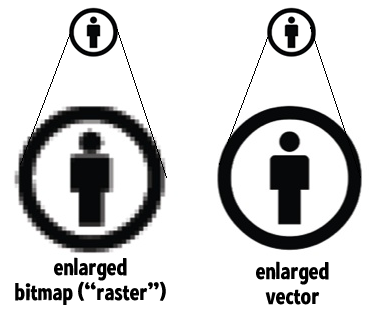
- Enlarging the image enlarges the pixels (creating a jagged effect and reducing resolution). This can be fixed by anti-aliasing (blend image to background).
- To calculate file size (kB) of an uncompressed bitmap image:
Horizontal pixels × Vertical pixels × Bit depth
----------------------------------------------------------------
8 × 1024
- Vector
- Composed of primitives (basic shapes)
- Each line has mathematical coordinates for start and end points (but no points in between, which reduces file size)
- Not suitable for photographs (no shading)
- Can be resized without loss of quality
- Animation
- Creating the illusion of movement
- Cell based – a sequence of images where each cell is slightly different to the previous cell and when played gives the illusion of movement
- Path based – a character follows a drawn line across the background
- Video
- Combines image and sound data
- To represent video in binary, each frame is represented as a bitmap = large file sizes
- To calculate file size for video:
- Calculate total frames (frames/sec × number of seconds)
- Calculate size of each frame (Horizontal pixels × Vertical pixels × Bit depth)
- Calculate total file size (frames × size of each frame = bits)
- Buffering prevents delay when playing videos
- Need to consider: frame resolution, frame rate, bit depth and bit rate
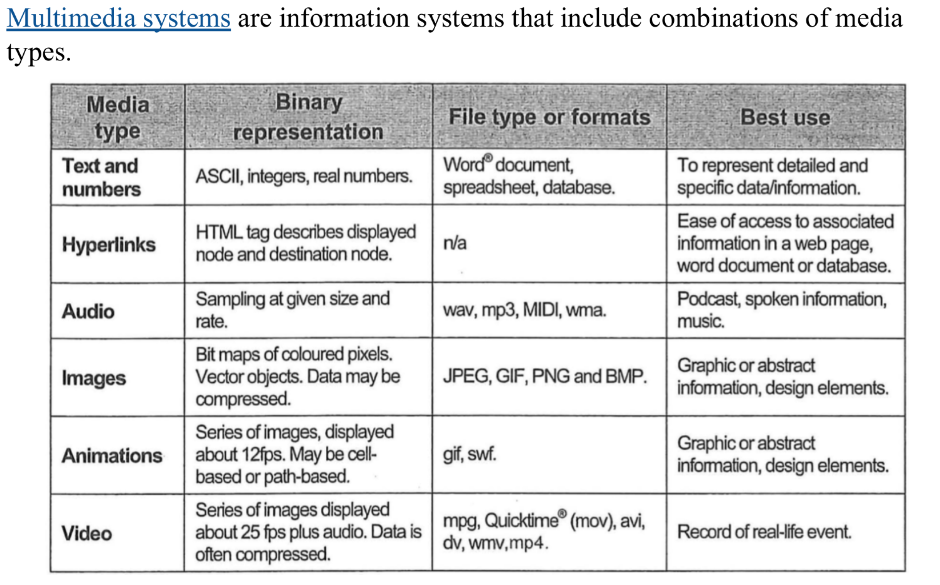
Table for reference to the above Media types
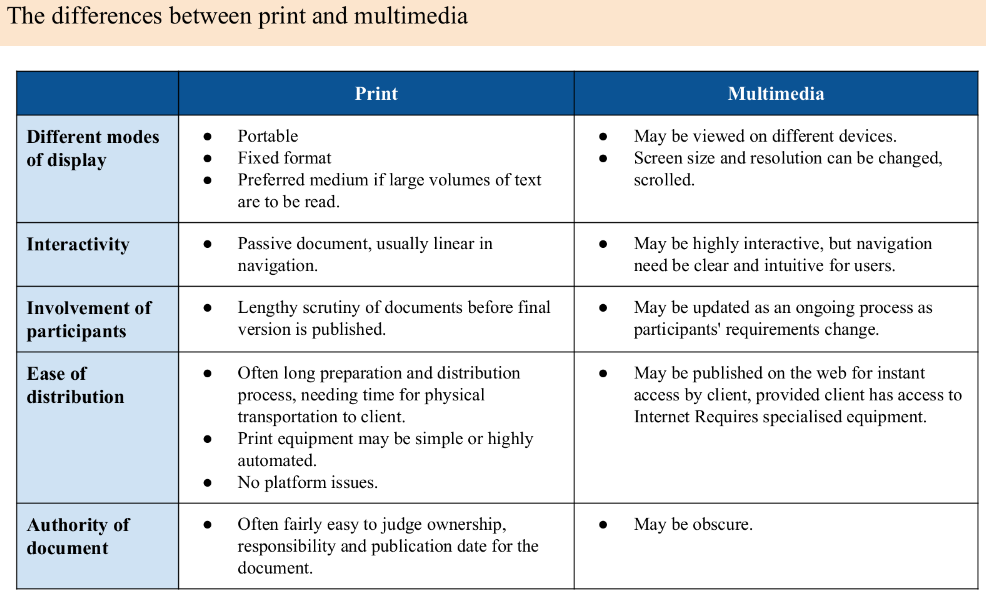
Differences between print and multimedia:
- Print has higher resolution than multimedia.
- Print is static = minimal interactivity. Multimedia is dynamic = designed for interactivity so user controls content (hypermedia, keyword searches, navigation buttons, site map, realistic displays)
- Print is harder and more expensive to distribute (heavy). Multimedia is easier to distribute (stored on lightweight devices; cheaply transmitted via internet)
- Distribution for print requires printing presses, ink, paper and willing publisher. Multimedia requires hardware, software and basic skills.
- Updates to print are not immediate (cannot be edited without reprinting). Updates to multimedia are immediate (e.g. online news).
- Print tends to be more trusted (books are checked by third parties)
Table for reference to the difference of media
Characteristics of Multimedia: Video